
In short
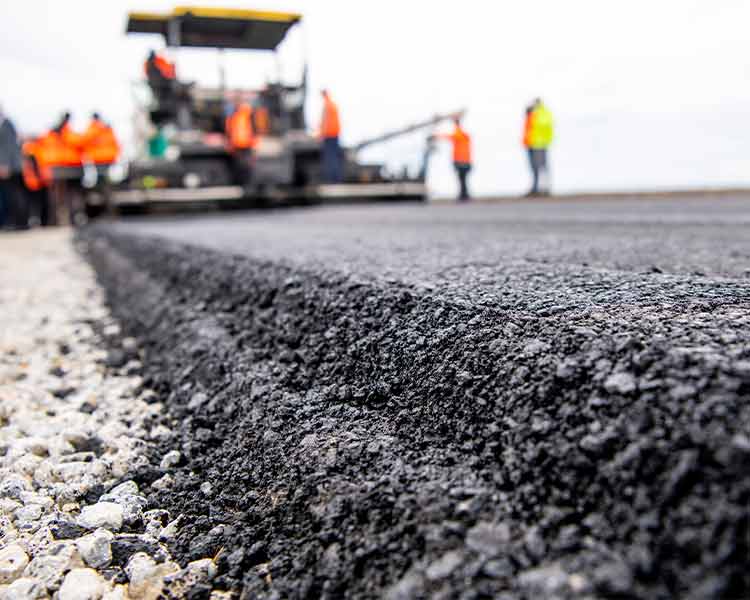
A tarmac driveway for cars is laid in two courses on a compacted stone sub-base: a base or binder course of around 60mm and a surface course of around 25mm, over at least 100mm of compacted Type 1 sub-base. Pavingexpert gives 100 + 50 + 25mm as the working minimum for a car driveway. Anything thinner than a two-coat build on a proper sub-base will show cracks and depressions within a few winters.
This is a job for our Tarmac & Asphalt service.
The three layers, and what each one does
People judge a tarmac drive by the finish, but the finish is the thinnest and least important layer. A drive that lasts is built from the ground up.
| Layer | What it is | Pavingexpert's guide thickness for a car driveway |
|---|---|---|
| Sub-base | Crushed stone (MOT Type 1) laid and compacted in layers on the formation | 100mm minimum, more on soft ground |
| Base or binder course | Coarser bitmac with larger stone, which carries the load | Around 50 to 60mm |
| Surface or wearing course | Finer, close-graded bitmac that gives the smooth black finish | Around 25mm |
Those are Pavingexpert's figures for a domestic drive used by cars. A drive that takes delivery lorries, a horsebox or a tractor needs a deeper sub-base and a heavier base course, and a working yard is a different design again. We size the build-up to the heaviest vehicle that will actually use it, not to an average day.
Why the sub-base decides how long it lasts
Tarmac is flexible. It follows whatever is underneath it. If the stone below is thin, poorly compacted or sitting on wet clay, the surface will ripple and crack no matter how thick the black layers are. Most of the failed drives we are asked to look at in Horsham and across the Weald were laid on too little stone over clay that holds water. The tarmac was not the problem; the ground was.
That is why our quotes set out the sub-base depth and the compaction separately from the tarmac courses. Two quotes that both say "tarmac driveway" can describe very different amounts of work under the surface.
One coat or two?
A single-coat drive laid straight onto stone is cheaper on the day and is the usual reason a drive fails early. The binder course does the structural work and gives the surface course something stable to bond to. We lay two courses on a new drive as a matter of course, and we explain the difference when a lower quote has only priced one.
Levels, thresholds and the damp-proof course
Thickness has a practical limit at the house. Pavingexpert's guidance, which we follow, is that a new surface should finish at least 150mm below the damp-proof course in the brickwork of the house or garage. At garage doors and doorsteps the finished level is fixed, so on a rebuild the dig-out has to make room for the full construction rather than the tarmac being thinned to fit.
How we specify yours
We visit, measure, look at what is under the existing surface and where the water goes, and write the build-up into the quote: sub-base depth, binder course, surface course and edge restraint. If an overlay would do the job we say so, and if the ground needs more than the standard construction we say that too.